AURORA ARC / DESIGN EXPLORATION

Evidence before claims.

Four sources, four design hypotheses and the exact limits of what they support.

Aurora Arc concept image
FOUR RESEARCH QUESTIONS

Why each design decision deserves a test.

Paper links are provided for source checking. We do not reproduce paper figures or assert that they prove the performance of this product. Previous local PDF copies were not available. / 提供论文原文链接供核对;不擅自复制论文插图,也不把文献结论等同于产品实测。此前四份本地 PDF 原件不可用。

How should the support follow the ear?
01 / EAR GEOMETRY

How should the support follow the ear?

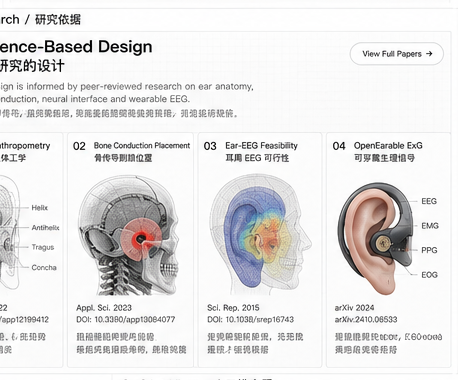
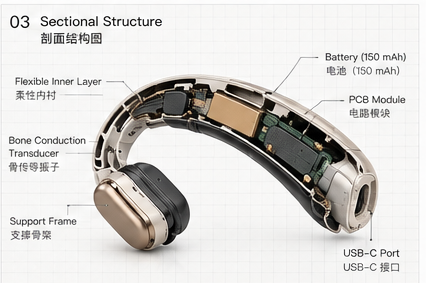
Ear-space and anthropometric modeling motivates a shape informed by ear landmarks. Design inference: use a continuous spine and soft liner. Required test: multiple ear sizes and contact-pressure mapping.

View original publication ↗
Why consider adjustable contact?
02 / STIMULATION POSITION

Why consider adjustable contact?

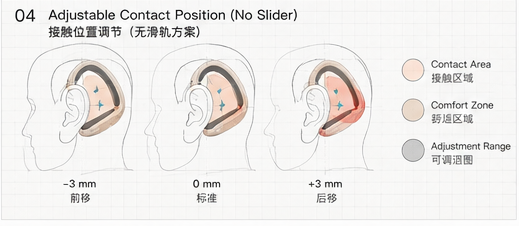
Research on bone-conduction stimulation sites and ear-canal occlusion suggests perception depends on test conditions. Design inference: compare contact positions. It does not justify a specific ±3 mm optimum.

View original publication ↗
What can be placed around the ear?
03 / EAR-WORN INTERFACES

What can be placed around the ear?

Around-the-ear EEG work illustrates the ear as a sensing location. It does not establish EEG or recording capability in this concept.

View original publication ↗
What future architecture is possible?
04 / OPEN-EAR RESEARCH

What future architecture is possible?

OpenEarable ExG provides an ear-worn biopotential research reference. Design inference: keep electronics modular where practical. This is not a validated product feature.

View original publication ↗

Evidence chain: publication → design hypothesis → concept drawing → CAD → physical prototype → validation. Only the early stages are present here. / 证据链:论文→设计假设→概念图→CAD→实体样机→验证。目前仅完成前期阶段。